Three words that decide your budget
Every listing in Orbi City, Alliance Palace, Black Sea Towers or the newer towers along Khimshiashvili Street states a condition: black frame, white frame or turnkey. The price per square metre of the apartment depends on it, and so does the renovation you will need afterwards. The problem is that no law defines these terms, and two developers' white frames can differ by ₾100 per square metre of finishing work.
We have renovated more than 120 apartments bought in all three conditions. This article explains what each term means in practice, what to check before you sign the purchase contract, and what it costs to bring each condition to a finished, rent-ready or move-in-ready apartment in 2026.
Black frame: what you really receive
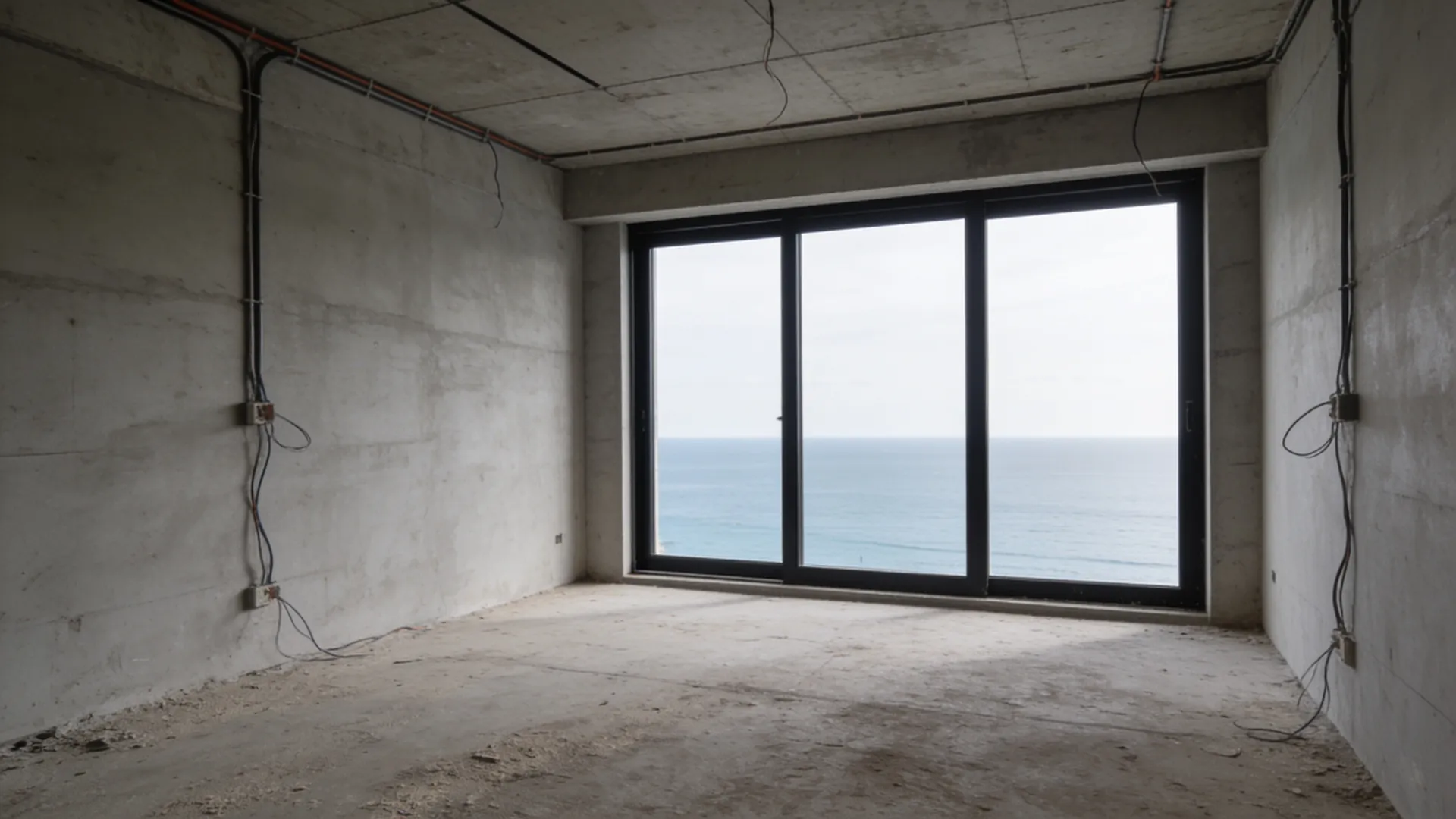
A black frame apartment is the structure and nothing else: concrete floor slab without screed, walls of block or concrete without plaster, no interior partitions or only the structural ones, windows installed (usually), an entrance door of the cheapest kind, one cold-water inlet and a sewage stub in the bathroom zone, and an electrical cable terminated at the entrance with no distribution board. No ceilings, no heating, often no balcony railings beyond the minimum.
The advantage is freedom: you decide where every wall, socket and pipe goes, and nothing has to be demolished. The disadvantage is cost and time: everything is built from zero, and the apartment is usually 2–4% smaller than the brochure because the brochure measured to the outside of walls that have not yet been plastered.
- Check: the condition of the slab — deviations over 3 cm mean a thicker screed and more cost
- Check: where the sewage stub is — moving a bathroom more than 3 metres from the riser is often impossible
- Check: the electrical allocation per apartment — 5 kW is common and insufficient for two air-conditioners, an induction hob and a boiler
- Check: the window quality — replacing a developer's single-chamber PVC later costs ₾400–700 per window
White frame: closer, but read the fine print
White frame adds plaster on the walls, a cement screed on the floor, interior partitions as per the developer's plan, roughed-in electrics and plumbing to the developer's standard layout, sometimes a suspended ceiling base, and occasionally a basic heating or air-conditioning provision. On paper it saves you the dirtiest third of a renovation. In practice, the quality of that third decides whether you keep it or redo it.
We have seen white-frame screeds that deviate 4 cm across a room and plaster applied without a primer that comes off with the wallpaper. We have also seen excellent white frames that needed only a skim coat. The only way to know is to measure: a 2-metre level on the floor, a straightedge on the walls, a look inside the distribution box, and a pressure test on the plumbing if the developer allows it.
- Good white frame saves ₾120–180/m² of finishing compared with black frame
- Poor white frame saves nothing — levelling a bad screed costs as much as pouring a good one
- The developer's electrical layout rarely matches a designed layout; expect to add 30–50% of the sockets and circuits
Developer turnkey: finished, but for whom?
Turnkey from a developer means the apartment has flooring, painted walls, tiled bathroom with sanitaryware, interior doors, a basic kitchen and sometimes air-conditioners. It is ready to rent the day after the keys. The materials are chosen by volume purchasing for hundreds of apartments: laminate at the lowest durability class, ceramic tile from the cheapest catalogue page, sanitaryware that will be replaced in three years, and almost never any waterproofing under the tiles.
For some buyers that is exactly right: a studio in a tower that will rent at a mid-range nightly price and be refurbished in five years. For an apartment you will live in, or one competing in the premium rental segment, developer turnkey is often a layer you pay for and then remove. The arithmetic is simple: the premium developers charge for turnkey is frequently more than the cost of a Standard renovation from a black frame — and the Standard renovation is yours, designed, waterproofed and under warranty.
- Developer turnkey typically adds $150–300/m² to the purchase price
- A RemontHome Standard renovation from black frame costs ₾450/m² and includes waterproofing, a new distribution board and a 12-month warranty
- Reworking a developer turnkey later means paying for demolition of finishes you already paid for
What it costs to finish each condition in 2026
From black frame, our turnkey packages are priced at ₾450/m² (Standard), ₾650/m² (Comfort) and ₾950/m² (Premium) for labour and rough materials, with finishing materials itemised by class. From a good white frame, deduct roughly ₾120–180/m² because screed, plaster and the useful part of the utilities already exist. From a developer turnkey, the question is what you keep: a cosmetic upgrade of paint, lighting, furniture and textiles typically costs ₾150–250/m²; a full redo costs the black-frame price plus demolition.
Timelines follow the same logic. A 65 m² black-frame apartment takes 55–65 days; the same apartment from a sound white frame, 40–50 days; a cosmetic refresh of a developer turnkey, two to three weeks. All of this is fixed in the contract along with the price.
- Black frame to Standard: ₾450/m², 45–65 days
- White frame to Standard: from ₾300/m² after inspection, 35–50 days
- Developer turnkey cosmetic upgrade: ₾150–250/m², 2–3 weeks
What to negotiate with the developer before you buy
If you are still choosing, the condition you buy is a negotiation point. Ask whether the developer will sell the apartment as black frame at a lower price even if the project is marketed as white frame — many will. Ask for the electrical allocation in writing. Ask whether partitions are structural or can be moved. Ask when the building's freight elevator is available to renovation crews and whether the management imposes a deposit or a per-day fee on contractors.
And ask us. We review developer plans for buyers free of charge, before purchase, and tell you what the apartment will cost to finish to each level — so the renovation budget is part of the purchase decision, not a surprise after it.
The condition matters less than the contract that finishes it
Whichever condition you buy, the apartment you end up with is decided by the renovation contract. A fixed price, a line-by-line estimate, a dated schedule with a penalty and a written warranty turn a black frame into an asset in two months. Their absence turns even a white frame into a year of change orders.
We have done all three paths in every major complex in Batumi — the 68 m² Comfort apartment in Orbi City started as black frame, the 42 m² Orbi Sea Towers studio as white frame — and the process on our side is the same: measure, design in 3D, fix the price, build, report weekly, hand over with a warranty.
FAQ
Is a white frame always worth the extra price?
Only if the work is good. We inspect the screed, plaster and utilities before advising. A well-executed white frame saves ₾120–180/m²; a poor one saves nothing and sometimes costs extra to correct.
Can I keep the developer's turnkey finish and just furnish?
Yes, and for a mid-range rental studio it is often the right call. We recommend at least checking the bathroom waterproofing and the electrical board before the first guest arrives.
Does the apartment area change between black frame and finished?
Yes. Plaster, screed and partitions reduce usable area by 2–4%. We measure the actual apartment before quoting so the price is based on real square metres.
Black frame, white frame and turnkey are starting points, not outcomes. Know what each one actually contains in the building you are buying into, measure before you trust the label, and finish it under a contract that fixes the price and the date. Send us the developer's plan and the stated condition, and we will tell you within 24 hours what it will cost to finish to each level.